
RAM Shortage Explained
- The current RAM shortage is structural and supply-driven, not a temporary disruption.
- AI infrastructure and High-Bandwidth Memory (HBM) are consuming a growing share of global DRAM capacity.
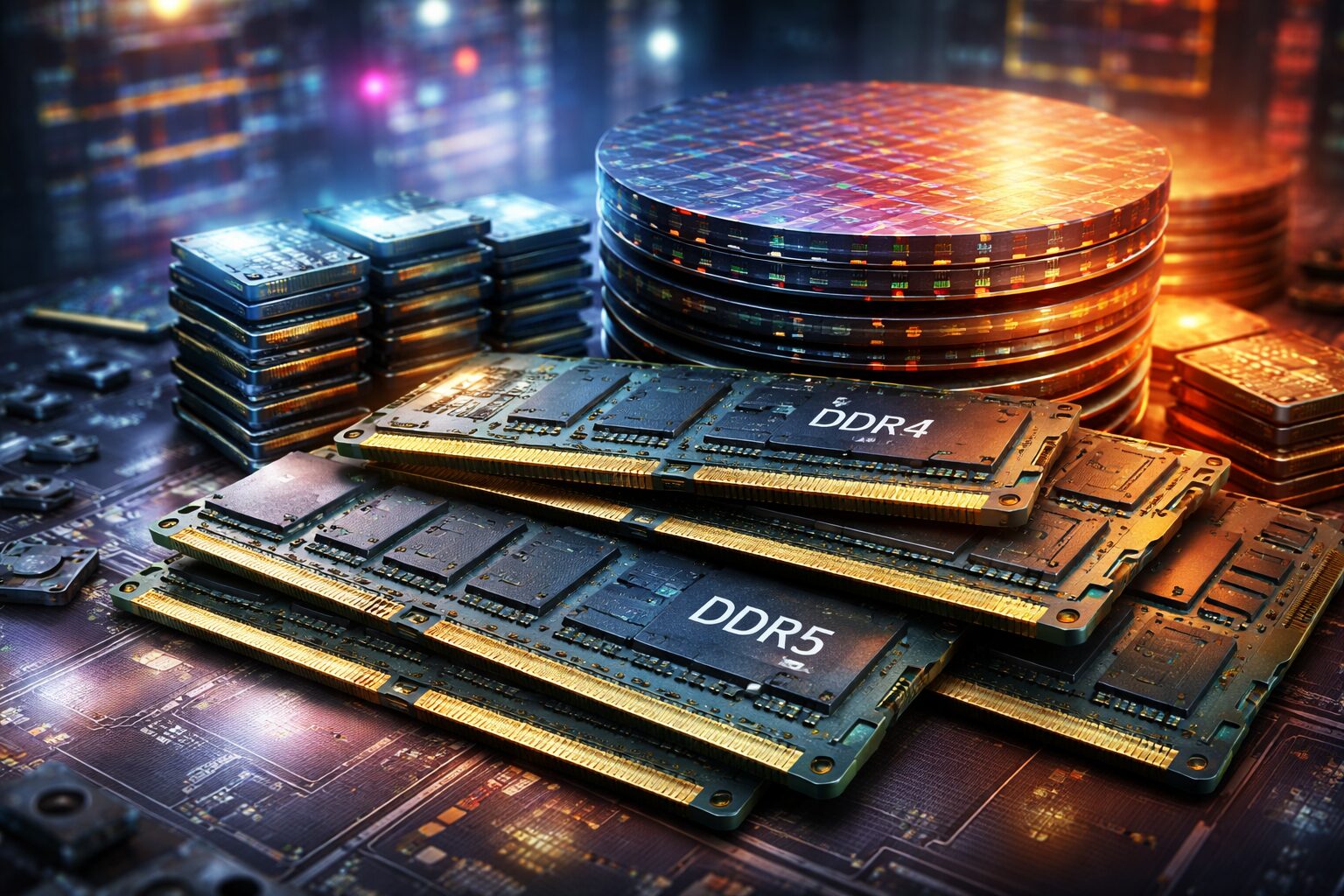
- DDR4 is entering a legacy scarcity phase, causing price spikes despite being an older standard.
- DDR5 is the mainstream future, but supply remains constrained because servers and hyperscalers receive priority.
- New DRAM capacity takes years to materialize; market analysts expect tight conditions into at least 2026, with gradual normalization afterward.
What Is the RAM Shortage?
The RAM shortage is a period of tight DRAM availability, extended lead times, and rising prices caused by memory manufacturers reallocating capacity toward AI-grade HBM and high-margin server memory, while reducing output of older products like DDR4. Because the DRAM market is dominated by a small number of suppliers, supply growth can lag demand for multiple years.
What’s Happening Right Now
As of late 2025, the RAM shortage shows up in three clear signals:
- Allocation-based sales for HBM and server DDR5
- Rising DDR4 prices driven by production phase-downs
- Lead times stretching beyond six months for certain memory classes
The imbalance is most severe in AI and server memory, but the ripple effects are now fully visible across PCs, smartphones, automotive systems, and industrial hardware.
1) What the RAM Shortage Really Is
This is not a traditional boom-and-bust memory cycle.
Historically, DRAM shortages were driven by consumer electronics demand swings or short-term supply disruptions. The current cycle is fundamentally different because it is reinforced by long-term strategic decisions:
- AI infrastructure demand is rising faster than historical compute cycles
- HBM has become a top-priority product class
- The “Big Three” memory makers — Samsung Electronics, SK Hynix, and Micron Technology — are maintaining strict supply discipline
- Legacy DRAM (especially DDR4) is being phased down earlier than many industries can absorb
Market analysts at TrendForce estimated average DRAM prices rose sharply in 2024 and continued climbing in 2025 as HBM gained a larger share of total memory revenue.
2) The Architecture of Scarcity: What’s Driving the Shortage
The 2025–2026 RAM shortage is a “perfect storm” of four reinforcing forces.
A) AI Demand Is Reordering Allocation
Hyperscalers and AI platforms prepay and sign long-term supply agreements. Smaller buyers cannot, creating effective shortages even when total output increases.
B) The HBM Pivot Is Capacity-Intensive
HBM is not just another DRAM product. It requires advanced stacking, specialized packaging, and far tighter yield tolerances. Reporting from Reuters repeatedly noted that HBM supply for 2024–2025 was heavily allocated or effectively sold out.
C) DDR4 Is Being Phased Down While Legacy Demand Persists
Industrial, automotive, and long-lifecycle systems remain tied to DDR4 and LPDDR4X. Production cuts create scarcity pricing even without demand growth.
D) New Fabs Do Not Solve Short-Term Problems
Modern memory fabs take three to five years to reach volume production. Micron has stated its Idaho DRAM output is scheduled to begin around 2027, with broader U.S. capacity arriving later in the decade.
3) HBM: The Wafer Vortex Behind the AI Memory Supercycle
HBM sits at the center of the current memory cycle.
By stacking DRAM dies in 3D, HBM delivers extreme bandwidth and power efficiency. Late-2025 HBM3E-class products are commonly described as exceeding 1.2 TB/s of bandwidth per stack, making them essential for modern AI accelerators.
Why HBM “Starves” Commodity RAM
HBM production consumes:
- Advanced stacking and through-silicon vias (TSVs)
- More manufacturing steps per usable bit
- Constrained back-end packaging capacity
As a result, even when wafer starts increase, a disproportionate share of high-quality capacity is absorbed by HBM, tightening supply for DDR4 and consumer-oriented DDR5.
4) DDR4 vs DDR5: Why the “Old RAM Is Cheaper” Rule Broke
This phenomenon is often described as the Great Memory Inversion.
DDR5: The Forward Standard Under Pressure
DDR5 adoption is driven by new CPUs and servers. However, the same production ecosystem serves high-density server memory, which hyperscalers prioritize. This keeps supply tight despite growing output.
DDR4: A Legacy Scarcity Crisis
DDR4 has become scarce because:
- Major suppliers are reducing output
- Long-lifecycle industries cannot switch quickly
- Buyers stockpile to avoid future shortages
Key takeaway: DDR4 prices can spike not because the technology improved, but because reliable supply is disappearing.
5) Comparison: DDR4 vs DDR5 vs HBM3E
| Type | Best For | Why It’s Scarce | Price Behavior | Practical Move |
| DDR4 | Legacy PCs, industrial, automotive | Output is being reduced | Highly volatile | Secure supply early |
| DDR5 | New PCs and servers | Competes with AI allocation | More stable than DDR4 | Default choice |
| HBM3E | AI GPUs and accelerators | Contracted + packaging-limited | Premium, allocation-based | Long-term contracts only |
6) Industry Impacts: Winners, Losers, and Survival Strategies
PCs: The “AI PC” Paradox
AI PCs require more RAM just as memory becomes more expensive. Budget upgrade paths are narrowing, especially for DDR4 systems.
Smartphones: Margin Compression
Mid-range smartphones face RAM specification pressure as memory costs rise and help shift capacity toward AI systems.
Automotive and Industrial: Long-Lifecycle Risk
Redesign cycles are slow and expensive. Legacy memory availability, not just price, is the primary risk.
Cloud and Hyperscalers: Capacity Capture
Large cloud providers lock supply via prepayment, leaving smaller enterprises exposed to allocation and delays.
7) Supply Chain Reality: Tools, Packaging, and Geopolitics
The bottlenecks have shifted upstream:
- Advanced packaging throughput
- Specialized bonding and metrology tools
- Export controls and equipment access
Even with sufficient wafers, packaging capacity now limits high-performance memory output.
8) Big Three Strategies: Samsung vs SK Hynix vs Micron
SK Hynix
Leads in HBM packaging and allocation strategy, positioning itself at the center of AI memory demand.
Samsung Electronics
Leverages scale and product diversity, capturing margin gains across both advanced and commodity DRAM.
Micron Technology
Focuses on supply discipline and U.S. manufacturing expansion, with new DRAM output planned later in the decade.
9) 2025–2030 Outlook: What Happens Next
2025–2026
- Elevated prices
- Allocation-driven purchasing
- Tight DDR4 and server DDR5 supply
2027–2028
- New capacity begins to ramp
- Potential price stabilization if AI demand moderates
2029–2030
- AI-first equilibrium
- HBM dominates value share
- Commodity DRAM managed as a margin-protected segment
Strategic Imperatives: What to Do Now
Consumers and PC Builders
- Prefer DDR5 for new builds
- Avoid DDR4 unless platform-locked
- Buy earlier than you think you need
OEMs and Procurement Teams
- Shift from just-in-time to forecast-based purchasing
- Secure longer contracts
- Begin redesign planning for DDR4-based platforms
Automotive and Industrial Users
- Treat DDR4 phase-down as an obsolescence risk
- Start qualification planning immediately