

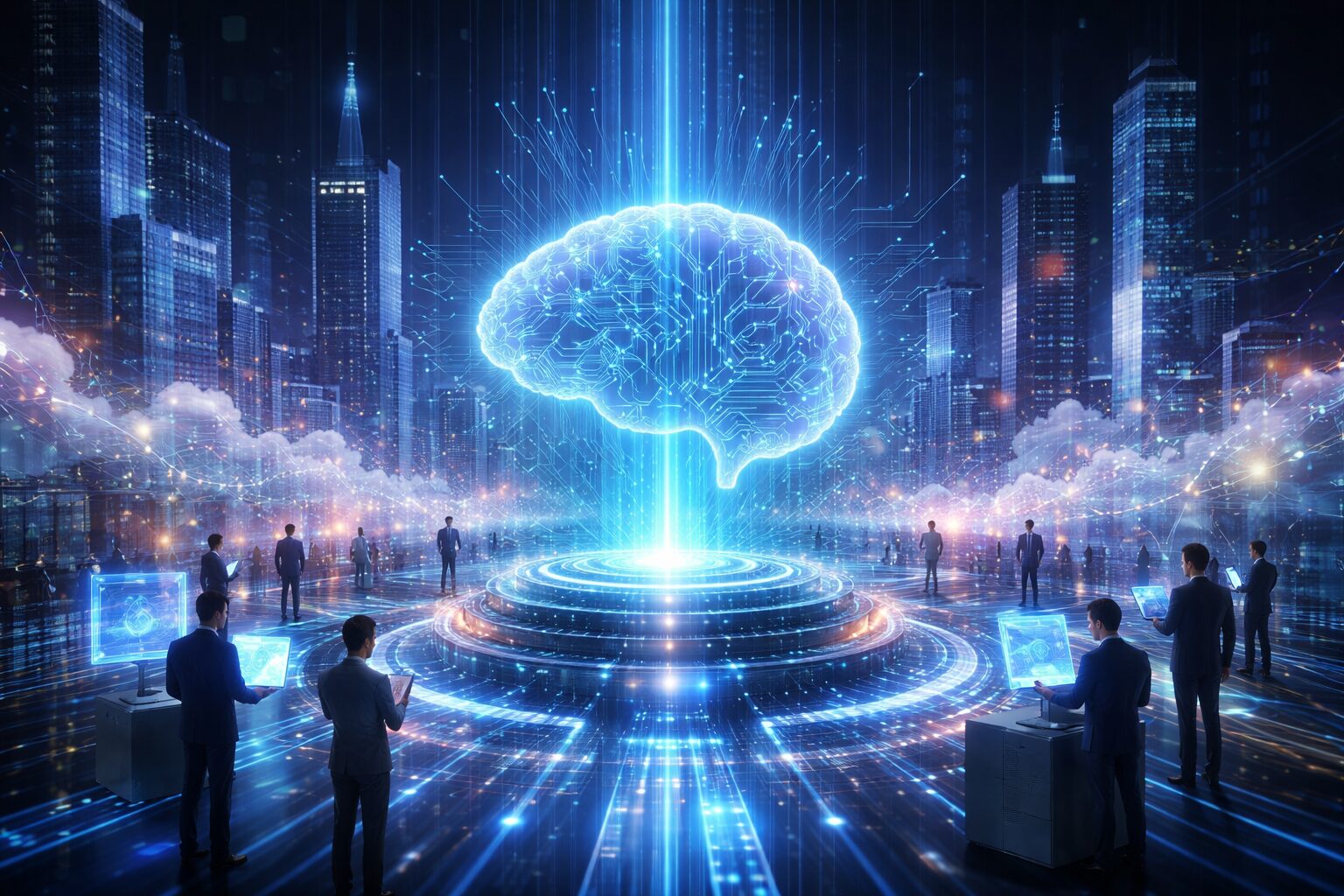
AI Is Becoming the Core Layer of Everything
For years, AI sat off to the side.
It helped write emails, summarize docs, generate code. Useful, but still a tool you opened when needed. Something separate from how work actually ran.
That separation is starting to disappear.
The shift now is not about AI getting better at assisting. It’s about AI becoming part of the operating layer of business, software, and even physical systems.
The data makes that clear.
Adoption Is No Longer the Story
Most companies are already using AI.
Stanford’s 2025 AI Index reports that 78% of organizations used AI in 2024, up from 55% the year before. McKinsey puts that number even higher, with 88% of organizations using AI in at least one business function.
That kind of jump would have been the headline a few years ago. It isn’t anymore.
What matters now is how deeply AI is embedded.
Even with high adoption, only about one-third of companies say they are actually scaling AI across the organization. And only 39% report a measurable impact on enterprise-level profit.
So the real gap is not access or experimentation. It’s integration.
From Tool to System Layer
The clearest signal is where AI is showing up.
It’s no longer just in chat interfaces or copilots. It’s showing up in how companies structure work, allocate budgets, and design systems.
OpenAI reports more than 7 million ChatGPT workplace seats, with enterprise usage growing rapidly year over year. Users say they save around 40 to 60 minutes per day on average.
That kind of time recovery sounds incremental. At scale, it changes how teams operate.
At the same time, companies are moving beyond passive tools into active systems.
McKinsey found that 23% of organizations are already scaling agent-based AI somewhere in the enterprise, and another 39% are experimenting with it. Microsoft reports that 46% of leaders say their companies are already using agents to fully automate workflows or processes.
That is a different category of change.
Tools help people do work faster. Systems start doing parts of the work themselves.
AI Is Reshaping the Org Chart
The companies seeing the most value are not just plugging in models. They are changing how work is structured.
McKinsey notes that high-performing organizations are redesigning workflows, shifting management practices, and committing meaningful portions of their digital budgets to AI.
Microsoft goes further. It describes a shift toward “human-agent teams,” where work is organized around outcomes instead of fixed roles.
That starts to affect the org chart itself.
Instead of static departments, you get more fluid systems where people and AI agents collaborate inside the same workflows. Work becomes something that is orchestrated, not just assigned.
Once that happens, AI is no longer a feature. It’s part of how the company runs.
The Economics of Work Are Changing
The labor market is already reacting.
PwC’s 2025 AI Jobs Barometer shows that workers with AI skills command a 56% wage premium, up sharply from the year before. At the same time, industries with higher AI exposure are seeing much faster growth in revenue per employee.
Productivity is rising, but not evenly.
The World Economic Forum estimates that 39% of core skills will change by 2030, with AI and big data leading that shift. McKinsey data suggests that some companies expect workforce reductions tied to AI, while others expect growth.
This is not just automation.
It’s a shift in how work is defined, valued, and compensated.
At a macro level, the IMF expects this to play out unevenly, with advanced economies feeling the impact earlier due to their concentration of knowledge work.
AI Is Becoming Infrastructure
One of the strongest signals is where investment is going.
Stanford reports that U.S. private AI investment reached $109.1 billion in 2024, with global generative AI investment at $33.9 billion. That scale of capital is not going into small features. It is going into platforms.
NVIDIA describes this as a full-stack shift, spanning compute, networking, software, and deployment systems. In that framing, the data center becomes the core unit of computing for the AI era.
Energy systems are now part of the conversation too.
The International Energy Agency points out that AI deployment is directly tied to electricity demand from data centers. When a technology starts influencing power planning, it is no longer just software.
It is infrastructure.
Beyond Software Into the Physical World
AI is also moving out of purely digital environments.
Stanford’s AI Index highlights more than 200 FDA-approved AI-enabled medical devices, a massive increase over the past decade. Autonomous systems like Waymo are already delivering over 150,000 rides per week.
These are not experiments.
They are operational systems embedded in healthcare and transportation.
Once AI starts interacting with physical systems at scale, the boundary between software and the real world begins to blur.
The Gap Between Leaders and Everyone Else
Despite all of this progress, adoption is still uneven.
Large enterprises are moving faster, with deeper investment and clearer strategies. Smaller firms are lagging. The OECD notes that AI adoption among small and medium-sized businesses remains relatively low compared to larger organizations.
That gap matters.
If AI becomes the core layer of how businesses operate, then uneven adoption creates structural advantages. Some companies will be built around AI from the ground up. Others will be trying to retrofit it into older systems.
The difference between those two approaches will compound over time.
What Actually Matters Now
It’s easy to focus on how many people are using AI tools.
That’s not the real signal anymore.
The clearer signal is how many companies are redesigning around AI.
They are changing workflows, reallocating budgets, hiring differently, and preparing to manage AI agents as part of normal operations. They are treating AI as something closer to infrastructure than software.
That is the shift.
Conclusion
AI is no longer just something employees open in a browser tab.
It is becoming part of how companies are staffed, how software is built, how products are delivered, and how infrastructure is financed.
The companies that win will not be the ones that simply adopt AI tools.
They will be the ones that rebuild around it.
Because once a technology starts reshaping org charts, labor markets, data centers, and energy demand at the same time, it stops being a tool.
It becomes the system everything else runs on.